For my foreign friends
Dear foreign friends,
So that you may know a little about me I am taking the liberty of saying a word of recommendation, giving information about my activities.
I am the practitioner of lacemaking.
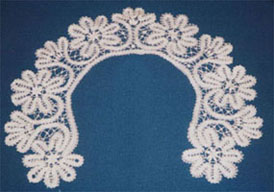
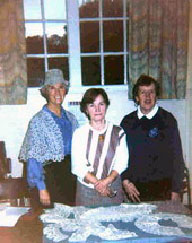
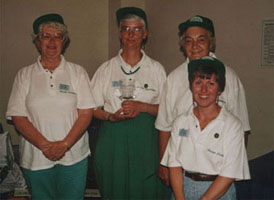 For about 20 years I have been teaching children and adults the technique of bobbin lace.In 1994 I was invited by Chairman of Border Lacemakers Mrs Jennifer Hester to take part in courses which have helped British teachers and practitioners of lacemaking in Gwent and Herefordshire to know the techniques of Russian bobbin lace and also the history of bobbin lace in Russia. I gave them six lessons. You see the team each of them could make the collar in the techniques of Russian bobbin lace in consequence. There in Usk I was delighted to meet Pat Perryman who has taught lacemaking at The Royal School of Needlework. She was so kind that gave as a present me the book «New Designs Honiton Lace» written by her.
For the last ten years I have been studying the history of development of bobbin lace. The aim of my research is proof that the bobbin lace is not the gay child of Renaissance as thought the professor Ilg but one of the most archaic creation as thought Digby Wyatt and Владимир Стасов. I could do it after I had read the monograph of Peter Collingwood « The Technique of Sprang Plaiting on Stretched Threads».
I introduce to you the article «About the question of manufacturing method of head-coverings from Roman Egypt» kept in a Hermitage library and the article «The peculiarities of Russian pillow lace» that I have written and that I gave a report at The VI Congress of Ethnography of Russia that was held in St. Petersburg from 28th June through 2sd July 2005.  As I told the creation of these articles were impossible without the monograph of Peter Collingwood « The Technique of Sprang. Plaiting on Stretched Threads». I expressed him my deep appreciation for helping that his book had assisted my work. I had been in communication with him when I heard with deep regret of his death. I extended to his sun my sincere sympathy in a loss so grave. It was deep sorrow that his book given as a present me by him turned into given as a keepsake one.
I would be most grateful if you could become acquainted with those articles.
Sincerely Yous
Natalia Abushenko, nat-abushenko@yandex.ru
About the question of manufacturing methods of head-coverings
from Roman Egypt
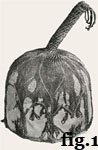
The open-work cloth head-coverings were presented by Nobuko Kajitani in her lecture at the Manchester Meeting in September, 1994 (1). In the speaker’s opinion they could have been worn in the beginning of late Hellenistic period and in the early Islamic period in the Greater Mediterranean regions. So far as these head-coverings may be found practically in the collections of all museums of the world, it can be conjectured that there have been a mass production of head-coverings because they were easy to make.The manufacturing methods of these head-coverings have been an open question and Nobuko Kajitani as a convenience uses the word “sprang” to name them.
I am taking the liberty of making a guess about these manufacturing methods using a well preserved sample of head-coverings kept in a Hermitage collection, namely the sample inv. №61616; 13106 (fig.1).
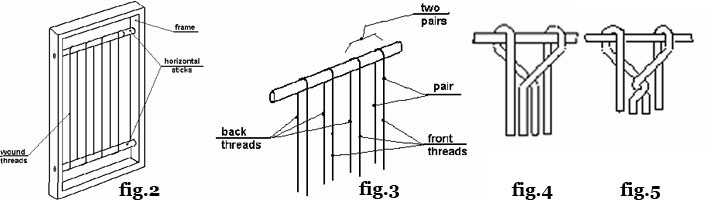 |
It was established and confirmed experimentally that the open-work cloth of this head-covering was made by carrying out two movements – crossing and twisting. For all that the threads have to be wound on two horizontal parallel sticks fixed in a frame.
The manufacturing methods will be better explained by means of the illustrations: fig.2 shows the frame with threads wound on two horizontal sticks; the names of the elements of plating are shown on fig.3; the movement of crossing can be seen on fig.4; the movements of crossing and twisting can be seen on fig.5; the final result of this technique – framed-open-work cloth–is shown on fig.6.
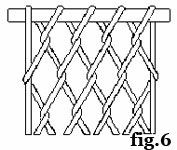
The maker begins the pattern by selecting four threads, taking a pair in each hand and carrying out two movements – crossing and twisting. Crossing consists of placing the right-front thread of each pair over the left-back thread of each pair (fig. 4). Twisting consists of placing the left-back thread of each pair over the right-front thread of each pair (fig. 5). Repetition produces plaiting (fig. 6). These two movements are the basis of framed-open-work cloth of head-covering №61616;13106.
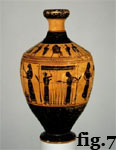
But the same two movements – twisting and crossing – are the basis of old bobbin-work (2). Consequently, we may consider it established that the bobbin lace developed from framed-open-work cloth, like the needlepoint lace developed from drawn-thread-work and open-cut-work embroidery (the Punto tirato, Punto tagliato, the Reticellas of Italy, Punto in aria) which appeared first in Italy in the 16th century (3). However, in our case the manufacturing methods may be traced to the epoch at least a thousand years earlier. The image of a head-covering on the Attic pottery lekythos (fig.7) is of the same form as we have (4), and permits to assume that these manufacturing methods have been exiting for a long time B.C.
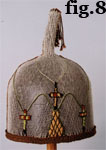
As an evidence, I attach a photo of the copy made by myself in 2002, of the head-covering №61616; 13106 (fig.8).
NOTES
- Nobuko Kajitani. Early Textiles Study Group, the Manchester Meeting, September 1994.
- Freeman, Charles, Pillow Lace in the East Midlands, Published by the County Borough of Luton Museum and Art Gallery, 1971, p. 22.
- In the same place, p. 9.
- Head-coverings from Roman Egypt in the collection of the Metropolitan Museum
- Peter Collingwood, The Technique of Sprang, Faber and Faber, 3 Queen Square, London,1974.
THE PECULIARITIES OF RUSSIAN PILLOW LACE
Pillow lace made in Russia differ from West European lace, at least, in two points: one of them is that it is considered to have developed in Europe in the late 15th or early 16th century, while in Russia first reference to pillow lace was registered in the 13th century.
Another, not less essential peculiarity of Russian pillow lace, is that in Russia, alongside with the lace made according to a pricked parchment pattern (draft), from aged-old times up to the present time lace has been also made without using any pre-existing pricked parchment pattern (draftless). This type of lace is absolutely unknown in Europe. So, according to the method of its manufacturing, all the lace made in Russia may be divided into draft lace and draftless lace.
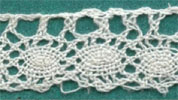
Draft lace is made in strict accordance to a pricked parchment pattern (draft) presenting a set of holes controlling in which pins are placed to be wound by threads of many bobbin pairs.
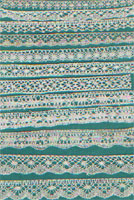
Draftless lace is also made with many bobbin pairs, but without any draft. The design depends completely on the fancy and intentions of the lace-maker. Pins, playing very important role in making draft lace, in this case are practically absent, their role is played by improvised materials, for example, by acacia thorns that are stuck only on the borders of the lace to keep it in place on the pillow. In 1910, Е.Polovtsova, a specialist in lace-making, very precisely and poetically compared draftless lace with a verbal tradition that disappears together with the people who knew it. It can also be compared with an unrecorded folk-song: it exists, but at the same time it runs the risk of disappearing irrevocably under adverse conditions. This type of lace was very numerous in olden times and we involuntary admire the skill of our grandmothers who made lace of most various design and up to 25 cm in width without pre-existing drawing and almost without pins.
Draftless lace should become an object for consideration by specialists who study the history of pillow lace, especially after the appearance of the book “The Techniques of Sprang” by Peter Collingwood, because, if to assume that plaiting on stretched threads, as described in the book, is the predecessor of draft pillow lace, then we should expect that the draftless lace is an intermediate stage between plaiting on stretched threads and pillow lace-making according to a draft.
The Russian Ethnographic Museum has the most valuable draftless lace collection and is ready to acquaint experts and the public with it.